Sunday, 13 January 2019
Badgers Oak Tunnel (South end)
A view looking back to the North portal.
A view towards the South portal.
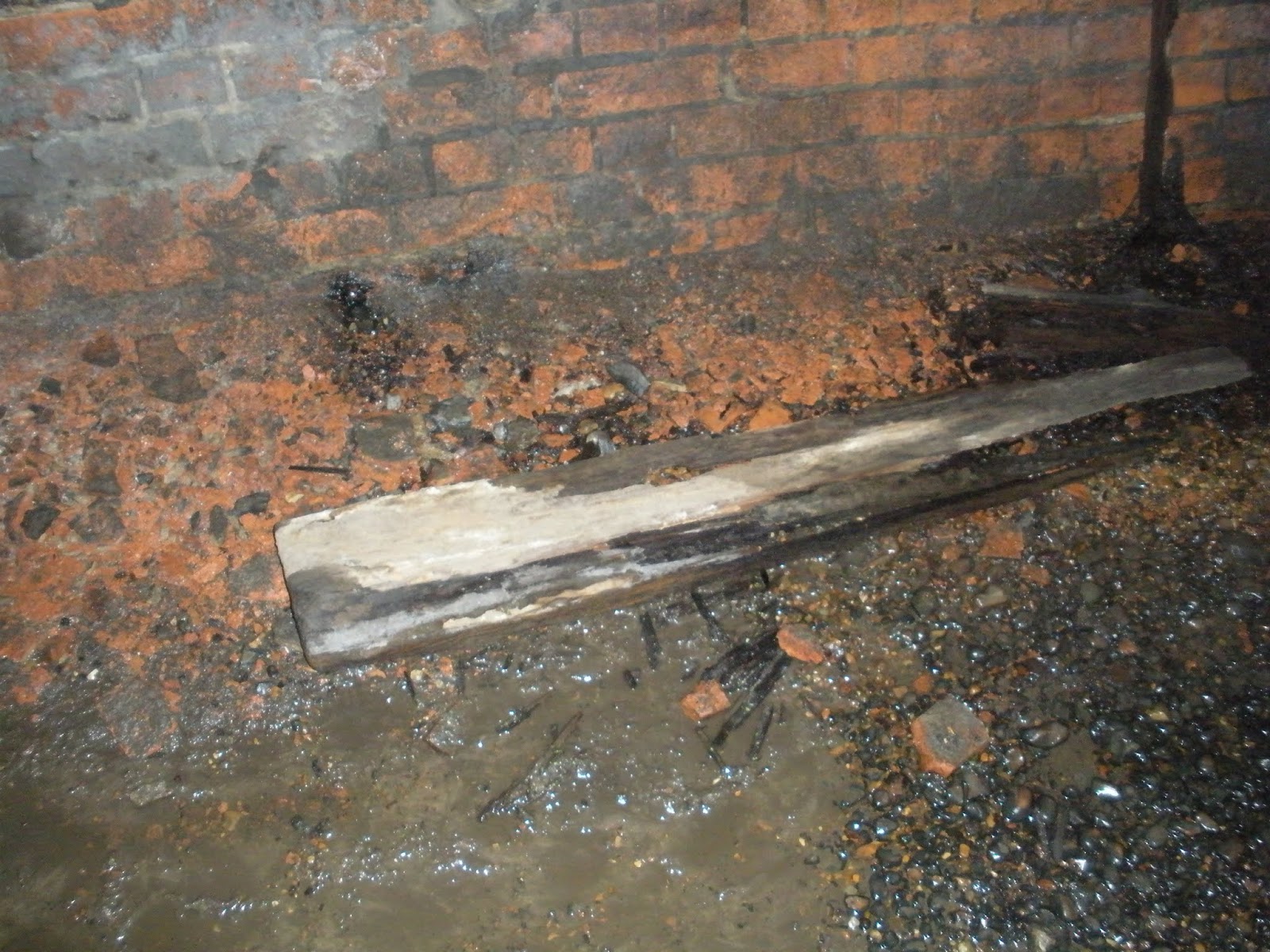
I did find one very rotten old railway sleeper in the tunnel.
Another refuge. (There are only four altogether.)
The engineer who marked out the sections of the tunnel was not the same person who marked out Horsmonden tunnel.
Yes, you've guessed it!
It is not so wet here.
(Looking north.) The curvature of the tunnel is quite noticeable here.
Outside the tunnel now, and again this tunnel has large retaining walls. (Horsmonden Tunnel has no retaining walls like this.) Here the tunnel number is displayed much more clearly showing no. 1532 (Horsmonden was 1472).
The South Portal is different from the North Portal and Horsmonden Tunnel! This has a four brick lining, I have never noticed this before or read about it.
This tunnel has always had problems with water ingress, even during it's working life. There is an old photograph in Peter Harding's possession showing the tunnel being constructed from the North Portal, I suspect that the engineers began constructing with a three brick lining but switched to four bricks at some time during construction because of their concerns over water ingress. I would say that the wettest part of the tunnel is probably about a third of the way in towards the North Portal.
The retaining walls keeping the banks in place are many bricks thick.
It was quite possible to clamber up one of the retaining walls for another snap. Watching a steam locomotive bursting out of the tunnel would have made a wonderful photograph!
Above the tunnel one of the capstones has been pushed down onto the track bed. These large lumps of masonry must have been very heavy. Did the builders use a crane to get them in place?
What a view! Again from above the tunnel the line begins to descend at last at 1 in 80 on a straight line.
Point of impact! The remains of the other capstone on the track bed.
I feel that the tunnel will become unsafe in a few more years if it is not maintained. I only found the remains of one old railway sleeper and there were no old rails that I could see.
Saturday, 12 January 2019
Badgers Oak Tunnel (North end)
This was the highest point of the line at about 200 feet above mean sea level. There are quite a lot of videos and accounts of peoples visits here so I am expecting it to be very wet and a little 'creepy', there are also supposed to be old abandoned railway sleepers and an even an old rail according to one 'Youtuber'.
The last swamp before the tunnel.
The Northern Portal looks the same as Horsmonden Tunnel, and this too has a three brick lining. The vegetation obscures a clear view of the design in the brickwork.
The paint on the original PWH tunnel reference number has been eroded away over the years.
As I entered the tunnel the sounds of bird song diminished to be replaced by the sound of hundreds of drips falling from different parts of the roof. Maybe that is why it feels creepy to some people.
Once more the same red bricks have been used. Like Horsmonden there are 'bleed pipes' set in the walls every five meters or so. They are all dry though. This one seems to have been cemented in rather badly.
The walls are very wet in some places as water streams down from the roof.
Wet mud covers most of the floor.
A shot of the wet roof. White calcite deposits are more apparent than black soot deposits. (Why did I not manage to get a picture of the roof of Horsmonden tunnel?)
Brick particles cover the floor. (This seems quite concerning.)
Calcification has began on some of the brick work. The constant dampness has caused a chemical reaction in the bricks, leeching out salts and impurities.
A shot of the first refuge. Here the tunnels are different, I am about six feet tall and I was able to stand upright in one with my head brushing the top of the arch, I had to squat in Horsmonden tunnel as it was at least six inches lower.
More brick chippings.
A second refuge, this one is in good condition. Why are there always broken bottles found in places like this? A person would have to be really depressed to sit in a dripping dark tunnel getting sloshed!
The inside of another refuge in a poor state of repair. The bricks have crumbled away exposing the bare rock behind.
Some of the bricks in the wall are missing too.
The tunnel is somewhere between 172 and 178 yards long depending on who's account you are reading. I wisely bought a torch, and a coat with a hood (which I had to raise immediately) but I only wore walking boots as I had left my wellies in the shed and have lost the keys somewhere in the garden! Fortunately the water never went over my boots. I felt ever so slightly uneasy at one stage but I don't usually mind places like this. If, however, the tunnel had been longer and wetter then it may have unnerved me! Despite being at a higher elevation the tunnel is much wetter than Horsmonden tunnel, but at least the water can drain away down the track bed. Horsmonden Tunnel is so full of rubbish that any water in there can't escape easily (see my 2015 blog).
Hall Farm Bridge to Badgers Oak Tunnel [part three]
It must have been quite a sight in Victorian times looking up from the wood towards the top of the embankment to see a train hauling its wagons to the highest part of the line. Finally, the industrial revolution had reached this part of Kent!
The land around is rising up again as we approach the tunnel.
There was one more area of fallen trees that went on for about 40 meters and had yet to be negotiated (I have learnt to take my glasses off in these situations since loosing them in similar terrain north of Horsmonden tunnel) and then more swamp before the tunnel was reached.
Badger Oak Tunnel looms into view as we enter the final cutting.
A view from the side of the track bed.
I know that I have gone into a lot of detail but experience has taught me that this could all be gone tomorrow.
I would rather have too many records of what was left as at January 2019 than not enough.
Hall Farm Bridge to Badgers Oak Tunnel [part two]
All the way from Hall Farm Bridge the track bed is still rising at 1 in 80, but swamps still keep appearing bringing back memories of Horsmonden South cutting before it was filled in. I would not like to do this walk after heavy rains!
In some places where there has been water recently the ballast used on the track bed is apparent.
What are these? There are two square brick structures one each side of the track. One Youtuber thought that they were the remains of a bridge
There are also the remains of wooden steps going up the bank (perhaps the others are buried under leaf mulch, or have rotted away.)
These structures had covers once, the broken parts of one lies nearby. Pipes drip water into a kind of sump. It appears to be something to do with drainage.
Another bog!
Someone's doing fine.
Old railway sleepers border the track bed. This one is looking particularly worn out.
The track bed has risen again, this embankment is very high, it could be the highest one on the whole line which was at 49 feet.
This picture shows how quickly the land falls away at the side of the embankment.
Hall Farm Bridge to Badgers Oak Tunnel [part one]
I felt that I had better cover the rest of the railway to Hawkhurst, there is a lot of footage on the internet but I have never been here before. Hall Farm Bridge as it was called can be reached by a small private road just off of the A299 and close to Station Road which led to Cranbrook Station. the Bridge covers a considerable cutting and Hall Farm is just the other side of it.
Paddock Wood to Hawkhurst Railway (bridge no. 1529)
Another view of part of the bridge with the farm beyond.
It is nice to see that this structure still exists. Again the same type of red brick has been used as in all the other structures, although these seem to be some of the newer bricks and 'PWH 1529'
appears to have been painted on top.
Looking north from near Hall Farm Bridge towards Cranbrook Station as it was 10th June 1961.
Looking south from the top of the bridge the line finishes its curve from Cranbrook Station and begins heading due south, it is now in a fairly deep cutting which shows how quickly the terrain varies.
There was was 'twitcher' wearing binoculars, lurking at one end of the bridge, so I introduced myself and asked him if he knew a way down to the trackbed? He didn't. He was however pleased that the the abandoned railway is here because the trees attract a lot of insect life which is good for birds. (He then went on to moan about greenfly; 'thirty years ago you could drive for ten miles in the summer time and your wind screen would be thick with insects but now you can drive for one hundred miles and collect very few'. It's easy to mock people like the Green fly man but he has a point, many farmers chose to use pesticides to increase crop yields which has undoubtedly reduced the price of food but it has also destroyed the source of food for many birds.) I decided to leave the twitcher and ascend from the side of the bridge.
Hall Farm Bridge from the track bed (Cranbrook Station side). You can see clearly from down here that many of the bricks have been replaced.
The bridge abutments must tower about 30 feet above the line, why are there pipes' in the brick work? A lot of effort and expense must have gone into building this farm bridge, how many bricks must it have taken?
-
Onwards. There is a lot of mud, - it looks like I am going to revisit my boyhood!
A look back at Hall Farm Bridge from the south.
A last peep back around the curve of the bend. Mosses and ferns abound.
It does give me an idea what it may have been like for a driver of the milk train seeing the bridge emerging out of the morning mist.
(I am unable to upload any more large pictures so I will continue this as a separate post.)
-------------------------------------------------------
Friday, 11 January 2019
Old film footage available on the internet
There have been quite a few short films available which show the railway in it's heyday. I am not able to find most of them now but if I come across any I will post the links below. I can't promise that they will still be there in six months time however. (You just need to copy the address of the chosen footage and paste it into your browser and hit the 'return' key.)
https://www.youtube.com/watch?v=9LHmjPmM-fw
This is part of an early 1950's film on Youtube which shows Goudhurst Station platform at that time (in the film the train continues to fictional 'Barden'.) The characters are supposed to be hop pickers from London, although I don't think the working classes had middle class accents.
-------------------------------------
https://player.bfi.org.uk/free/film/watch-adventure-in-the-hopfields-1954-online
The entire film 'Adventure in the Hop Fields' is available here and is free to view.
-------------------------------------
https://www.youtube.com/watch?v=PO69U5Blvxo&t=45s
This footage shows the branch line in 1958. The narrator on this seems to be very knowledgeable. It is particularly interesting because for a large part of it the camera is mounted on the drivers cab giving a 'drivers eye view' I am struck by how green everything was that summer and how slim the people were.
-------------------------------------
I must have had a 'physic flash' 30/11/2020 I felt the need to re-check Youtube for footage literally two minutes after Peter Smallwood had uploaded old cine film of the journey from Hawkhurst to joining the Main Line in the spring of 1960. The film is blurry in places but very interesting.
Subscribe to:
Posts (Atom)
