Sunday, 19 April 2015

First letter to London and South-Eastern Railways (SouthEastern)

Thinking about this situation it seems to me that with the discovery of oil in the Weald of Kent it may be worth a punt writing to London and South East Railways who operate the section of track which includes Paddock Wood. In Victorian times companies would have been more ready I feel to expand their influence in such an eventuality, still.
         Ideally I would love to see the entire line running again perhaps with steam locomotives at weekends, but if even part of the line is salvaged then that would be a good start.


Dear Sir/Madam

With the discovery of oil deposits in the High Weald of Kent and Sussex I suggest that you consider conducting a feasability study into re-opening the section of line between Paddock Wood Station and Horsmonden (which was closed by BR in 1961). This would give you a base in the High Weald and options for transportation for much of the crude oil in a cheaper and more environmentally friendly way than by road. It sould also provide South Eastern Railways with an enviable income stream which your competitors would not have access to.

By the late 1950's I know that the Hawkhurst Line became loss making but Horsmonden was always one of the more profitable stations. This was owing to the proximity of the community it served and the wide variety of farm produce that it supplied. I believe that re-opening the line would allow access to much of this farm traffic plus increased revenue from commuters to London, Maidstone and Ashford whilst reducing the increasing strain on Paddock Wood Car Park. Perhaps using one diesel shuttle service between the stations at regular intervals would cancel the need for electrification and reduce the requirement for signalling, so greatly reducing costs.

The distance of the former line was 4 3/4 miles and it was well engineered to cope with the climb up from Paddock Wood. Using the Paddock Wood Southern Bay platform the first 2/3 mile would run parallel to the Ashford Line before branching south accross fields for a few miles on nearly level ground with only a few minor roads to cross. Within Horsmonden parish the half mile long embankment still exists which climbs steadily at 1 in 66 before a cutting is reached (partialy infilled) prior to the tunnel which is also still in good condition. It is only south of the tunnel that the deep cutting to the station site will need to be re-excavated.
I look forward to hearing your thoughts and any suggestions of what the community can do to increase the likelihood of this becoming a reality.

Yours faithfully


Laurence Arnell
Friends of the Hawkhurst Railway


--------------------------------------------------------------------------

I feel a bit of a fraud using the above title as I am the only friend of the railway at this stage.

Meanwhile I wait with baited breath for a response.

---------------------------------------------------------------------------

Letter back from South Eastern

Dear Mr Arnell

Thank you for the letter dated 19th April, which you sent to our Managing Director, David Statham. Mr Statham has asked me to respond on his behalf.

I understand that you would like to see the line between Paddock Wood and Horsmonden reopened after it was closed back in 1961. From your comments I see that you feel this would offer more transportation options for commuters travelling in this area, and would alleviate any strain on the current mainline services we operate on the line between Tonbridge and Ashford.

I appreciate the time you have taken to bring this proposal to our attention, but this kind of decision would not be taken by an individual train operating company. If a line was to be reopened then this would have to be considered by Network Rail who are the company who manage and maintain the railway lines in this country. So what I will do is forward your letter to them so they can reply to you on the points you have raised. For reference, their contact details are :

Network Rail
1 Eversholt Street
London
NW1 2DN
Tel:03457 11 41 41
www.networkrail.co.uk

Once again, I'd like to thank you for bringing this suggestion to our attention.

Your sincerely

Russell L D'eath
Customer Relations Team Leader
Southeastern

-------------
Well at least they answered, I am sceptical about Network Rail doing the same, still, I have their address and can now inundate them with letters if I feel so inclined. Meanwhile I believe that oil is to be drilled in the Lamberhurst area (possibly close to the original site of Goudhurst Station) will we be seeing large tankers on the roads and unhappy residents? Also, will there be lots of supporting industries springing up which will use heavy plant equipment that will require transportation?

-------------

6th May 2015 letter back from  Network Rail (dated 29th April)

Our reference 150429-000246

Dear Mr Arnell

Thank you for contacting Network Rail..

Your enquiry has been passed to our local Community Relations team who are investigating the issue as quickly as possible. For your convenience the enquiry has been assigned the unique Service Request number: 150429-000246

In the meantime should you need to contact Network Rail again, please do not hesitate to call our 24-hour National Helpline on 03457 11 41 41 quoting the reference number provided.


Yours sincerely,

Community Relations Team
Network Rail

------------------

I'm glad they responded.
Apparently it can typically take a few months to review a case, they look into the likely expense of repurchasing land and rebuilding bridges etc, likely passenger and goods traffic and even check that rare wildlife have not colonised areas of the trackbed.

------------------

As at 8th June the enquiry is still ongoing and I am starting to get a bit nervous although I don't expect it to be successful (it will at least 'be on the radar' for a while afterwards and Horsmonden council will have to think twice before allowing any building developments over the old trackbed). I tried to bring this subject up with a member of the Horsmonden Historical Society but was disapointed by their apathy, unfortunately when I mentioned that there is oil in the Weald which may well be drilled near Horsmonden they had not even considered it.
If you would like the line reinstated from Paddock Wood to Horsmonden please write to the local MP as it may take a political will to drive it through, if you are willing to help, your polite letter / email could make all the difference, (I am emailing him now but am not a local resident).
Greg Clark is the local MP and here is his web page:-
http://www.gregclark.org/contact-greg/
The enquiry reference with Network Rail is 150429/000246.

I think that this is the nearest we have got to re-instating any of the line for 54 years (the first and only enquiry that I know of).

22nd June: I received an email back from Rachel Godfrey, one of Greg Clark's staff asking me to let her know the outcome of the Network Rail enquiry!!!! Obviously Mr Clark is not interested in supporting the case for re-instatement of the line but Rachel Godfrey was trying to 'let me down lightly'. I'm sorry for the people who wrote to him (if anyone did) but at least you tried to do the right thing, there wasn't much point in having half hearted support from an MP and I had no expectations of him personally, meanwhile the enquiry goes on.

6th July and 8th July: I have phoned Network Rail for the results of the enquiry twice this week, Unusually the case is still ongoing (the average enquiry tends to last about two months). A lady has been allocated the case but is prumably awaiting further information, sorry, but I will update this as soon as I hear something. The fact that it is still being investigated is quite positive in my opinion.

17th July

I have had a response from Network Rail, here is the letter dated 15th July.


Our Reference: 150429-000246

Dear Mr Arnell

Thank you for your letter with regards to the line being re-opened between Paddock Wood and Horsmonden.

I must explain that unfortunately we do not cater for small freight flows any more, we are likely to develop a connection to a container terminal or other bulk flow rather than a farm due to the amount of investment required.

On the passenger front, it is unlikely that such a reopening would gain a positive business case due to the extensive earthworks, track laying, signalling and other civils and station construction costs which would require a very large passenger flow (especially from a single station) to pay back the cost of the works within 60 years let alone the extra profit required to make it viable. The 2011 census shows that there were just 1,620 people living in Horsmonden.

A diesel shuttle service is highly unlikely as diesel units are very expensive to maintain and operate, compared to a modern electric unit, and maintaining an extremely small fleet of units would be cost prohibitive for any operator. Electrification is not cheap and could cost a significant amount.

For an idea of the costs of clearing an in-filled cutting and reopening an old railway, you may wish to look at the East Grinstead Extension of the Bluebell Railway which they carried out 'at cost' or cheaper as they are a charity and had a lot of goodwill: http://www.bluebell-railway.co.uk//bluebell/extend.html

I hope that this response has provided you with the information you require. If you have any further questions please do not hesitate to contact our Helpline on 03457 11 41 41.

Best wishes

Gabrielle Kearns
Community Relations Executive
Communications

--------------------------------

Gabrielle Kearns
Community Relations Executive
Communications
1, Eversholt Street
London
NW1 2DN     
                                                                                                                      
Your Reference: 150429-000246
Dear Gabrielle,
Thank you very much for investigating my enquiry and responding with your letter dated 15thJuly 2015.
I have taken on board your points regarding Horsmonden’s small population, rail companies no longer catering for farm traffic and the costs of diesel maintenance / re- excavation of in-filled cuttings etc.
However should the site for oil drilling in the Lamberhurst area be fully developed and we are faced with a scenario where oil tankers are being used in large numbers I will write to you again in the hope that you will re-investigate the economics of the case (perhaps to Goudhurst station).
Yours sincerely
Laurence Arnell
 
-----------------------------
 
Well I may have been naive but I am so pleased I tried to do something.
A few positives have come from this.
 
1/ I feel happier that I raised the issued.
2/ The Hawkhurst Line is 'on the radar' still at Network Rail (and Horsmonden and Paddock Wood Councils perhaps).
3/ A few people will have learned a little about the old railway.
4/ For anyone who has been or might be implicated in building over the track bed news of an enquiry may have caused them a little consternation and they might think twice about causing any further damage..


Wednesday, 25 March 2015

Queen Street: Paddock Wood

I have just parked up at the Elm Tree Pub car park and I am walking towards the site of Queen Street Bridge which was the first road bridge that the line ran under after leaving the mainline.


                            The road begins to rise as I approach the site.


The line would have run North West towards Paddock Wood and the mainline. 


Or south east at this point on its way towards Horsmonden.


..............But looking down I'm afraid it is now just a bank. and that the bridge is now buried under piles of earth.


Monday, 23 March 2015

Part 3 In the Abandoned Orchard

                  Carrying on from the last post 'A sentimental Odyssey' continues...


 I clamber down through a hedge and into the next field, changing direction so that the line is now on my right and the beginnings of half a mile of embankment start to emerge (despite this the line still drops down towards Paddock Wood at 1 in 66 for another mile or so but of course the surrounding land drops more quickly).


I struggle over the electric fence at an easier point and up the bank which is perhaps 20 feet high now. Thousands of tons of gravel were brought down in wagon loads when this was built and most of the earth which was extracted from the cuttings and tunnel nearer to Horsmonden were added on top. Some of the exposed gravel on the bank can be seen here (birch stick and left welly also feature).


Looking North-West the embankment is clearly defined. I have not yet seen a single 'Private / Keep Out' sign throughout my journey or met a soul. 'Swigs Hole Farm' (Swigs Hall as it is now called) begins to emerge in the distance.


An old relic from the 1950's or 1960's ?


Another cock begins crowing as I approach Swigs Hole Bridge now and some odd objects are appearing in the distance which turns out to be plastic water tanks!


Beyond the water tanks access is barred by razor wire! They should be aware that children play around here. Sounds like a George Warleggan character from Poldark - I keep a close lookout for mantraps!! 


Above is a picture of the farm track heading towards the Maidstone Road from the side of the top of the bridge.


I had no choice but to slide down on my bum (you can see where the soil is disturbed)  but you can see also what a fine bridge this is. It looks wide enough for two trains but the line was only used for one track.


Above: A view from an earlier visit in February (Bethany had not fancied the scramble up so we had not met the razor wire then).


Above a very old style of fencepost a probable surviving relic of the railway era.


Well I want to carry on so I am forced to enter a rough field on the other side of the bridge parallel to the embankment. The field ends and I enter the next and then scramble back up the bank (below).


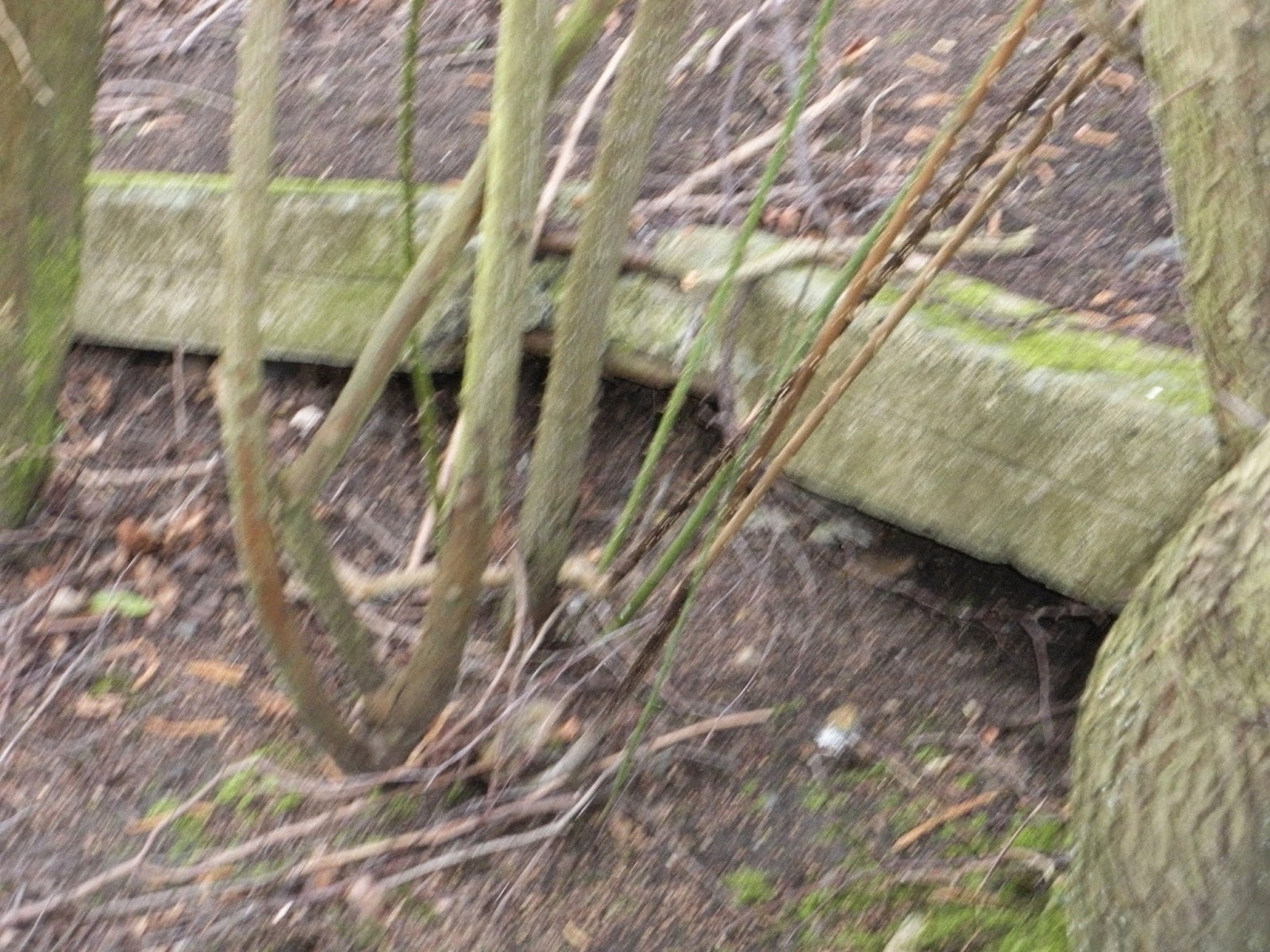
Two old sleepers held down by iron bars give testament to one of the last platelayers' maintenance efforts.


A blurry image of the track bed as I resume north once more.


Primroses.


Oaks, birches and willows have all colonised this ground. 


A pond appears below and to the North West.


'Happy Birthday Olivia - 9'


Goodbye Olivia!


Down the bank and to my right a stream appears from under the embankment.


With the aid of a piece of rope tied to a tree (probably left there by children) I scramble down and get a poor photograph of the 8 foot wide bridge over the culvert, due to the mud and fallen trees this is all I can get. (It is hard work extricating my boots from the sucking mud). Few people will ever see this, it will have been here from 1892 and some people once went to a lot of effort to build it. It has functioned every day since (I wonder how aware the local parish councillors even are of its existence).


Back up the embankment (using the rope) and along again, the stream meanders down and to my right on its way to join the Teise. Not long after this I start to hear intermittent traffic noise ahead and to my left so I must be approaching Yew Tree Green Road. Once there was a railway bridge here and the road went over the railway, is it still there?


A few minutes later and the embankment is discernibly lower. Ancient sleepers help to form the fence with the adjoining field. In the days of low population and minimum trespass (if that existed) the railway probably improvised with old railway sleepers and a few strands of wire as a fence, indeed our old back garden which backed onto the railway a mile or so further south originally had a fence like this. Fencing would have been a constant drain on resources for any railway company.


       This (willow?) gives out a delicious smell like honeysuckle just as the sun appears for a few seconds.


Above: The Northern end of the embankment begins to peter out.


Finally after a few more obstacles of the plant variety I emerge in the open to scrub land and piles of bricks. According to diagrams there had once been small cuttings each side of the bridge. It is very likely that the bridge does exist but is buried under piles of bricks and earth but there seems to be too much rubble lying around to merely be from the parapet of the old bridge.


Yes?


............A grand sounding title under the circumstances. I can't understand the economics of destroying a structure and then randomly dumping the bricks into an adjacent field, subsequently blighting it so that no crops can be grown and few animals (except mountain goats) can graze in it.


Yew Tree Green Road today (just another featureless lane with a slight bump where the bridge once stood).


(This was taken one evening a few months later). Looking across and down towards Churn Lane three or four fields away, the line headed towards Rams Hill but then began curving in a wide arc to the left.

120 or 100 years ago my journey would have taken perhaps 3 minutes by steam train,
50 years ago walking with some rubbish on the track bed perhaps 40 minutes walking, today (although not rushing) perhaps 3 1/2 hours.


The whole Hawkhurst Line history fascinates me but I am always left with a sense of sadness and despair when I see how little has been preserved. It ran into the High Weald and was built in an age of engineering prowess. It opened up Horsmonden and its farms to the rest of the country and from 1892 farmers could get their goods to market, it would no longer be a day trip by horses and carts to Maidstone or Tonbridge over poor roads. Also it helped feed Britain during the war when it's citizens were only a few months away from starvation and it connected villages and gave their inhabitants a new pride in their community. Its a pity today that there is so little knowledge or interest in the subject while the village has continued to grow.


Sunday, 22 March 2015

Part 2 In Horsmonden Tunnel from the last post.

There were two tunnels on this line, the other being near Cranbrook Station but neither would have been built under the original plans. Originally the line would run west of Horsmonden and then near Brenchley then south to Lamberhurst before swinging east to Goudhurst, but then it was decided that the line could be shortened by well over a mile by sinking a tunnel and running through Horsmonden. It must have been desperately disappointing for Lamberhurst residents as teams of navies had already started work in their area.


Looking North towards the Northern Portal and back towards the Southern Portal.


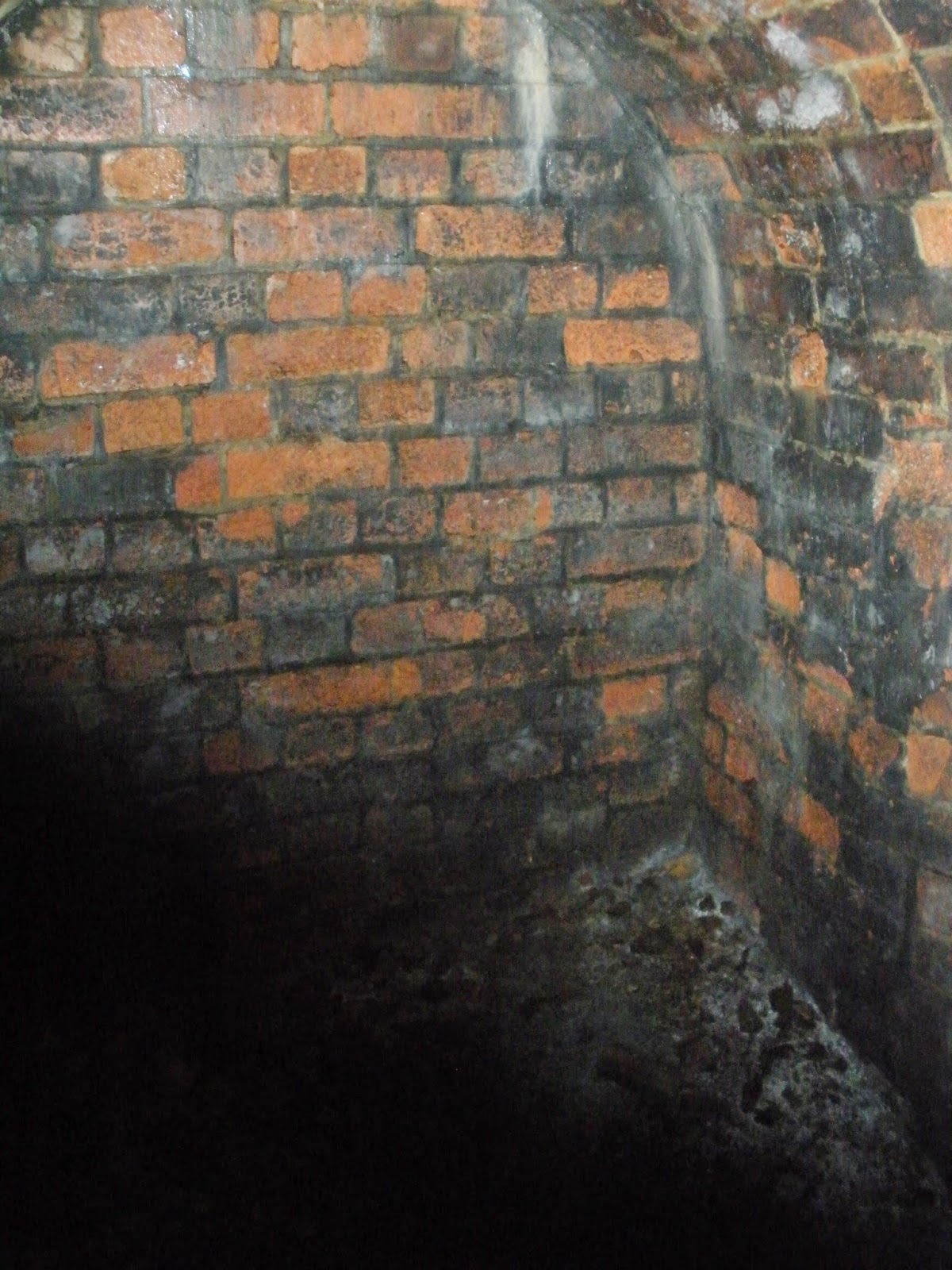
Calcite and grime deposits hide the red brickwork.


Layers of gloop and scum cover the floor.


The first refuge appears on the west side white washed in calcite deposits. It is impessively deep but only about 4 feet 6 inches high as if designed for a fat dwarf.


And a couple of pictures of the more northerly eastern refuge which shows it's brick work  to greater appeal.


And more markings from the maintenance team 60 years ago perhaps. It is a lonely feeling thinking that people once cared but now no-one seems to give a stuff.
 
 
Approaching the Northern Portal now.
 
 
..And looking back South. it is not always clear but the tunnel does curve slightly.
 
 
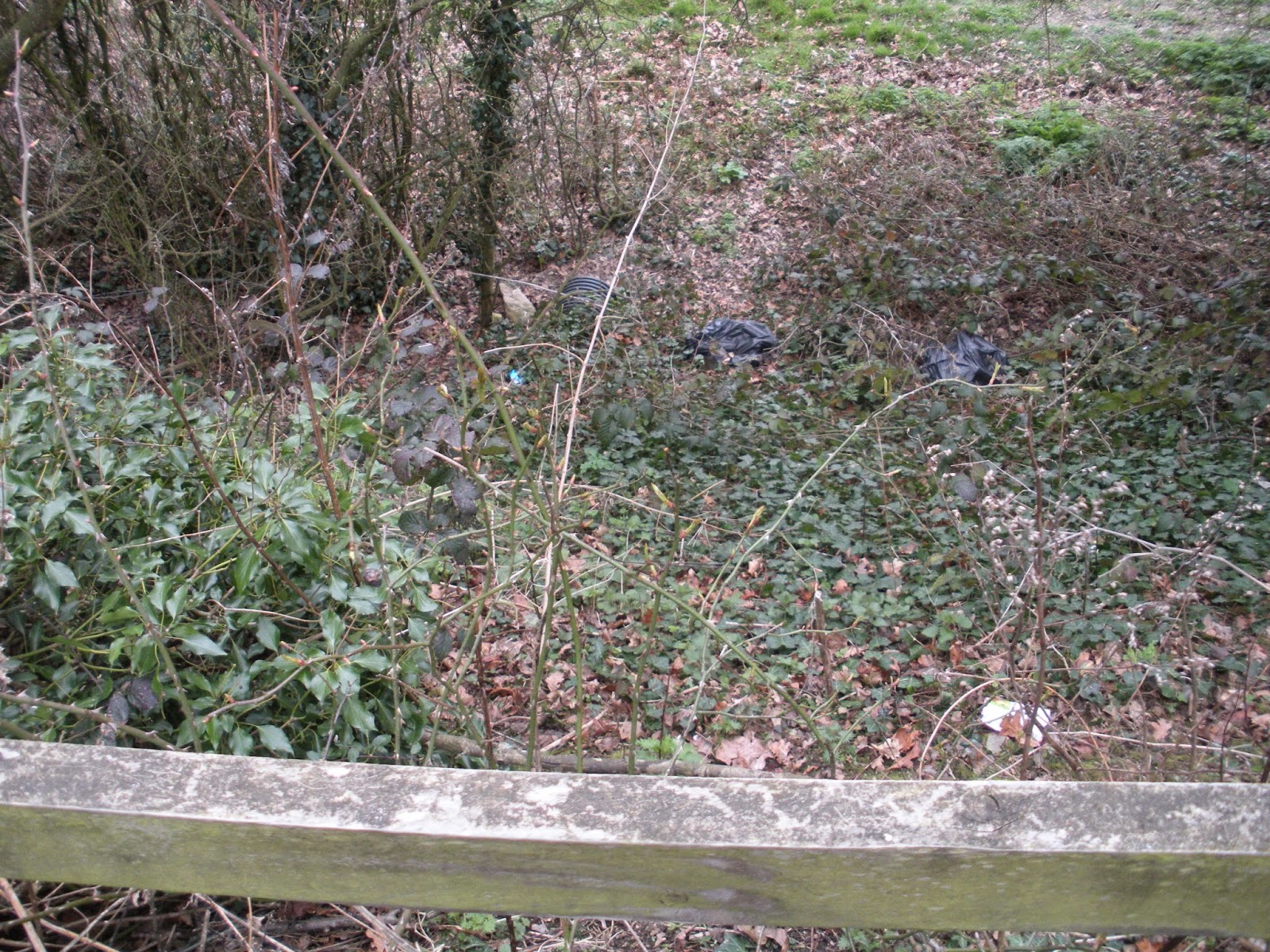
The view from the Northern Portal is like being half way up a mountain looking down a long valley that has a lot of fallen debris, lichen covered rocks and general rubbish dumped in it.


After some yards of scrambling over tree trunks and trying to avoid the swamp this is the view back.


Perhaps another 50 yards on.
 
 
There is no firm ground here it is a mad scramble and progress is slow.
 
 
This picture does not do justice to how impossible the terraine is. I hear the occasional car from the B2162 road over the tunnel but never hear anything else apart from an intermittant cock crowing. Above me up the bank on my right is a fence with an open gate, locals obviously throw their garden waste down here a lot.
 
 
I have had to move up and down the bank in order to make any progress. Here is one of the bogs which is fed by the leak in the tunnel lining seeping through all the obstacles blocking the Northern Portal. Most of the gloop has been filtered out now and the water looks cleaner.
 
 
Another look back at the tunnel through this crazy jungle. I loose my glasses somewhere among clawing branches and can't see anything, it takes ten minutes of desperate fumbling to find them. Above me that cock is crowing again.
 
 
A last look back (with my glasses back on again). The entire track bed to Goudhurst was apparently wide enough to support two tracks throughout, except for the tunnels and this cutting to the north of it, according to the Board of Trade report back in 1892 
 
 
Now the ground is getting easier and rising (when it should be dropping).


There are a number of osiers or willows which have been coppiced in the last two years. Someone is coming here intermittantly. There are also about 20 empty wine bottles, it looks like someone else likes a drink or 6!


Back to 'normality' and my birch pole is invaluable in getting through this lot. This forest of thorns is pretty intimidating, I wonder if Sleeping Beauty is anywhere about?


The cutting goes on.  The banks seem to be getting shallower though as they should be.


I think at this point the railway would be kinking around to the right and be at the end of the cutting but now I'm met with an electrified fence! It was around here that Horsmonden Station's down distant signal would be (1,035 yards from the signal box at Horsmonden Station according to Brian Hart's excellent book 'The Hawkhurst Branch'.) Up and to the right can be seen houses on the Maidstone Road.


Cheers!


This is the nearest the Hawkhurst Line ever got to electrification, an electrified fence. Never-the-less to avoid the fence I  take a left turn down a sort of track and find an abandoned apple orchard, it looks like nothing has been pruned for perhaps 8 years. I'm going back on myself now so I need to drop down into the adjacent field and then follow it along in line with the track bed.